 HOME
HOME CALENDAR


 NEWS
NEWS SPORTS
 OPINION


Las Vegas lost a legend in NASCAR driver Kyle Busch on Thursday, May 21. The Durango High School graduate died from severe pneumonia that progressed into sepsis at the age of 41. Fans have memorialized Busch by leaving flowers, signs, Monster Energy Drinks and M&Ms at the main entrance to the Las Vegas Motor Speedway.
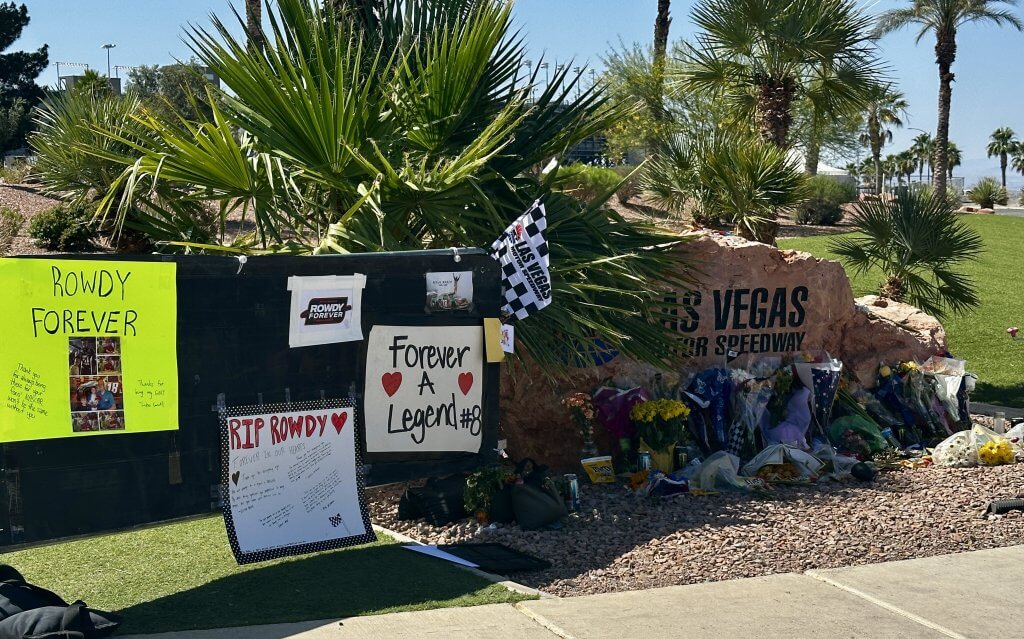
Fans left flowers, M&Ms and Monster Energy Drinks to memorialize local legend and two-time NASCAR Cup Champion, Kyle Busch, at Las Vegas Motor Speedway.
I’ve never followed NASCAR. In fact, my coverage of the motorsport consists of a single column suggesting legislation requiring politicians to advertise their biggest donors on their person at all times – like NASCAR drivers and their cars. But Kyle Busch didn’t care whether I followed the sport; he made himself known by transcending the sport.
Busch was a character to say the least. His nickname, Rowdy, comes from a villainous character in one of my favorite driving movies, “Days of Thunder.” It suits him, given his aggressive approach to racing and living. He was outspoken and, at times, adversarial. News of his post-race fights with other drivers found its way to me, which I always found more intriguing than the sport itself. Left turns might not get my attention, but left hooks do.
Busch embraced being NASCAR’s villain, providing the pro wrestling heel the sport needed to grow its following off the race track. I liken the loss of Busch to that of Owen Hart, whose iconic heel turn involved him attacking his brother and tag team partner, Bret. Kyle and his brother, Kurt, had a similarly heated rivalry before Kurt retired in 2023 after being concussed in a 2022 crash. Kurt was inducted into the NASCAR Hall of Fame this January, with Kyle as his presenter. Kyle will surely join him in short order.
Owen Hart’s 78-foot fall broadcast live on pay-per-view served as a wakeup call for the industry, as the wrong harness was used for his descending entrance from the catwalk above the ring. The stunt was completely unnecessary, but Hart, like all professional athletes nearing the end of their careers, was protecting his spot on the roster by doing whatever was asked of him. That included portraying a literal joke of a character.
Kyle Busch, similarly, was already a legend and still felt the pressure to perform regardless of circumstances. While still on the race track at Watkins Glen, May 10, he radioed his team requesting a doctor be made available to give him a shot for what was believed to be a sinus cold. A week later he won the Trucks Series race at Dover and finished 17th out of 36 in the All-Star Race. I’m wondering why he was racing at all. Doctors don’t just give you what I’m assuming is a “sinus cocktail” injection because you ask for it. Usually they give you a once-over; they listen to your lungs with a stethoscope so they don’t miss things like pneumonia. I have a friend who, also at around 41, thought pneumonia was a cold until he had trouble breathing and finally went to the hospital. He stayed there four days. He didn’t race any cars…or wheelchairs.

The G-forces NASCAR drivers experience when racing cause lower blood pressure, as the increased gravity makes it harder for the heart to pump blood to areas opposite the gravitational direction. Breathing also becomes more difficult because of the increased weight on the chest, limiting lung expansion and reducing oxygen absorption. All of this likely exacerbated Busch’s condition, but didn’t need to.
It’s not easy to convince any athlete to take a break, but NASCAR should have procedures in place for moments like this. Imagine if Busch had won at Watkins Glen and was unable to celebrate with his team in the winner’s circle or fulfill the required press availability. There would have been so many more questions and concerns about his condition, and NASCAR would have likely looked into it further.
I propose that any driver unable to fulfill the winner’s share of post-race responsibilities – regardless of where they finish in the race – should be required to see an independent doctor at a healthcare facility immediately. No more seeing doctors on the team bus or on pit road. Someone disconnected from the sport needs to explain to these drivers and their families the dangers of driving given their health, and it needs to happen in a hospital, because race car drivers are more comfortable going 200 miles per hour than they are in hospital beds. Hell, they’re more afraid of losing their rides than losing their lives.
Busch wasn’t adequately scared, and that’s why we’ve lost a legend far too soon and for far too ridiculous a reason. I can’t help but feel Busch’s death was avoidable, but Busch’s impact as a willful villain should pale in comparison to the impact his death should have on NASCAR and the health and safety of its drivers.